
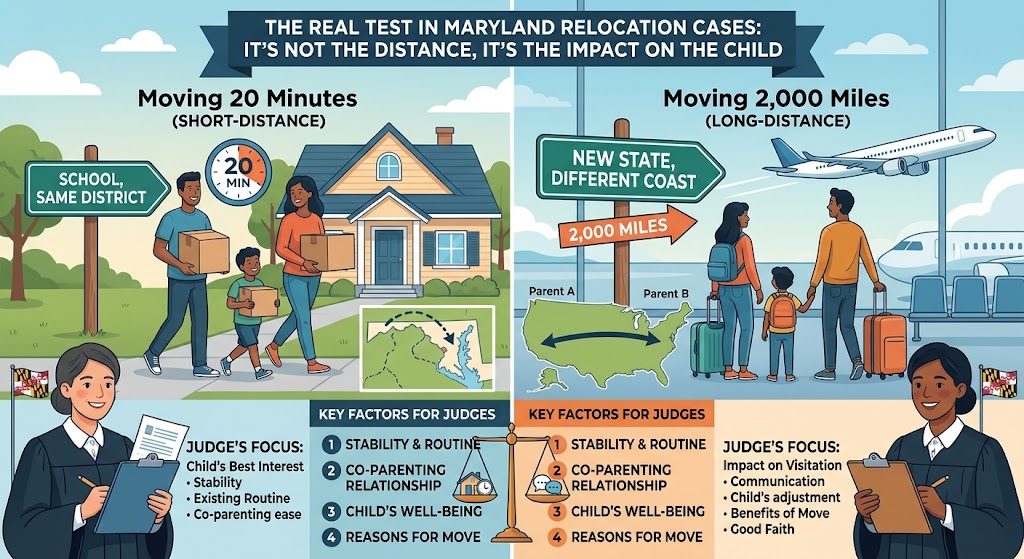
Ask most parents when a move becomes a legal problem and they answer with a number: ten miles, fifty miles, out of state. Maryland doesn’t work that way. Understanding what it does use instead can save you from two opposite mistakes: assuming a short move is safe, or assuming a long one is impossible.
For the full legal overview, see https://www.houlonberman.com/blog/maryland-child-relocation-laws/
There is no mileage rule
Maryland does not set a general mileage limit, and it has no single relocation statute with a fixed notice period. Courts decide relocation disputes under the same best-interests standard they use in every custody case. A move is not automatically allowed, and it is not automatically blocked.
So the useful question is not “how far?” but “what does this move do to the existing arrangement?”
The schedule test
Take your current order or parenting plan and ask three questions:
- Can the current schedule still run as written? If the child still makes the same exchanges at the same times, the move may have little practical effect.
- Who absorbs the change? If the other parent would now have to drive hours for a midweek exchange, the burden has shifted.
- Does the schedule need to be rebuilt? If a move turns alternating weeks into “school year with one parent, summers with the other,” the court will treat it as a major change.
Here is how those questions can play out. These are illustrations, not predictions. Judges decide each case on its own record.
| Existing arrangement | A move of about two hours | Why it matters |
|---|---|---|
| One parent handles school-day routines, the other has alternating weekends | May be workable with a revised weekend and holiday plan | The weekday structure may not need to be rebuilt |
| Near-equal shared physical custody | Likely to require rebuilding the whole schedule | A court may be reluctant to approve a shift to a long-distance pattern without strong reasons |
| The other parent is the daily school-day caregiver | Harder to justify | The move removes that parent from the child’s daily life |
Why a short move can still start a case
A planned move by a parent is usually treated as a material change in circumstances, which can open the possibility of modifying the order. Even a move that seems minor can change the practical reality of a shared schedule. If the move affects the other parent’s time, a signed agreement or a court order is the safest path. A handshake deal does not protect anyone if communication breaks down later.
Why a long move isn’t automatically blocked
Courts do not presume that the parent with primary physical custody may or may not move. Each parent has to make the case for what serves the child. A documented job offer, a family support network, or a better education option can be persuasive, especially with a credible long-distance plan. A move that appears designed to cut the other parent out of the child’s daily life is not.
Three steps before you decide anything
- Read your order for notice, consent, or residence restrictions.
- Run the schedule test and write down your honest answers.
- If the move touches the other parent’s time, talk to them in writing early, with the proposed date, address, school details, and reason.
Bottom line: in Maryland, the question is not how far you are going but what the move does to your child’s relationship with both parents. A Maryland family law attorney can apply this to your actual order. This article is general information, not legal advice.